
March 12, 2026
How much will I be paid as an early childhood educator?
By Liddy Korner
We are often asked… “How much will I be paid?” It’s a fair question, and it seems a lot of educators are not clear on the answer, or how they can find out. Understanding your pay level is an important part of this process.
No matter if you are new to Early Childhood Education or not, the Children’s Services Award (the conditions and pay rates determined by the Government) can be confusing for many.
One of the first things to be aware of is that the rate of pay is dependent on both your qualification level AND your experience.

What you should know
Let’s start by looking at the two awards that apply to this sector:
Children’s Services Award – this award applies to Certificate III, Diploma and any students working toward a qualification. The full payrates can be found here (go to Page 7 for casual) or check out our summary table below.
Educational Services (Teachers) Award – applies to Early Childhood Teachers.
*This article focuses on the Children’s Services Award (Certificate III & Diploma).

Casual educators are a crucial part of the workforce that keeps centres open and safe
The table below summarises minimum pay rates under the Children’s Services Award for Educators and the Educational Services (Teachers) Award for Early Childhood Teachers (ECTs). The Award column shows the base hourly rate for full-time and part-time employees, while the Casual column includes the 25% casual loading.
Please note that pay rates are typically updated on 1 July each year however, the rates shown below are valid from 1 March 2026, following the gender-based pay adjustments introduced by the Fair Work Commission. These changes apply to Children’s Services Award classifications only and do not affect ECT rates under the Educational Services (Teachers) Award.
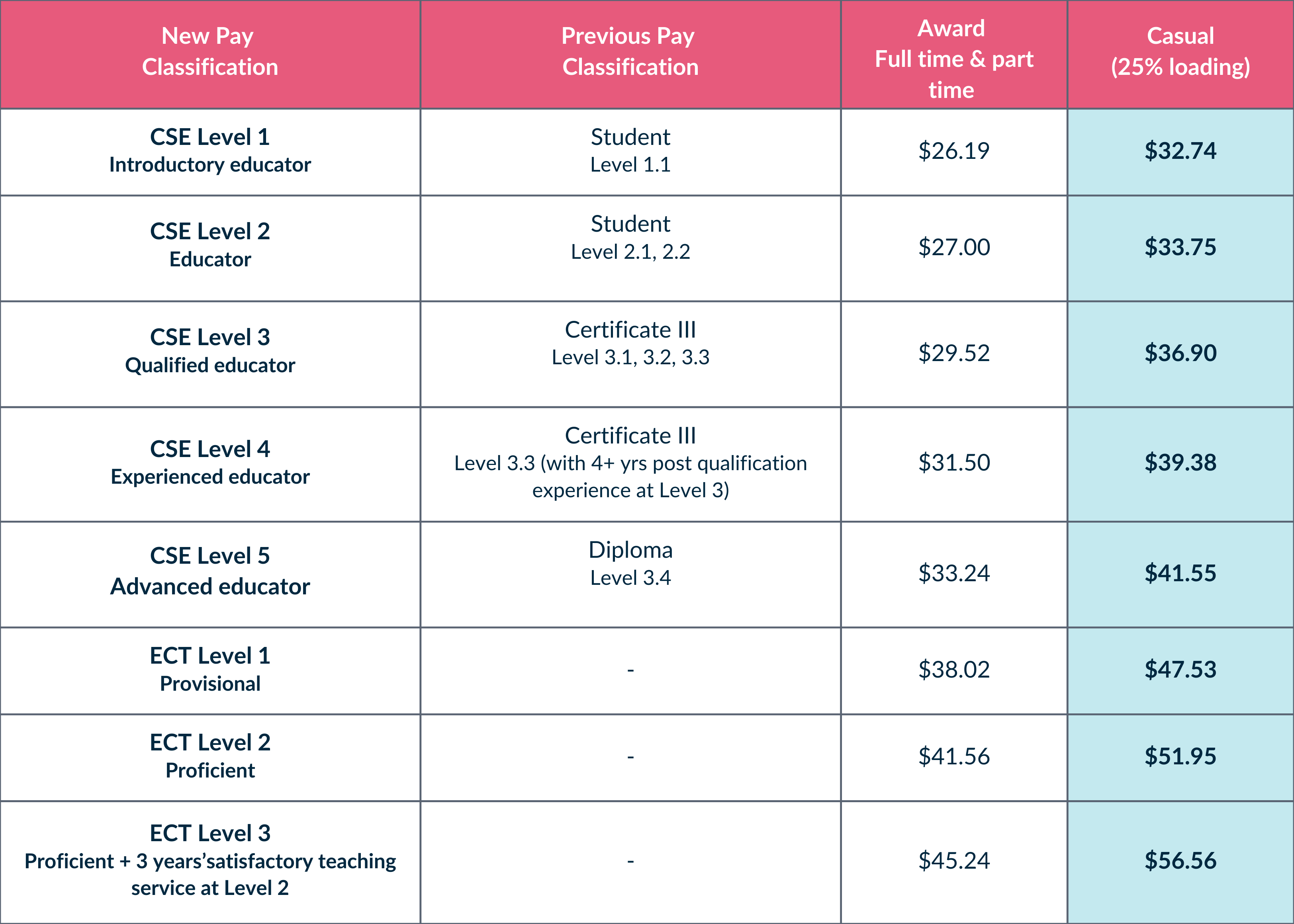
Note: This table includes Children’s Services Award classifications up to CSE Level 5 and Early Childhood Teacher classifications up to ECT Level 3. Higher classifications exist under the Awards, but in a casual employment context these roles are generally not required.
Did you know?
Casual payrates are 25% higher than permanent rates because casual employees do not receive entitlements such as annual leave, personal leave or other paid leave.Instead, casual employees receive a 25% loading, which is included in the hourly rate.
Students – Working Towards a Qualification
If you are a student who has not completed an ACECQA-approved qualification but you are enrolled and working towards one, you will generally be classified under the Children’s Services Award as either CSE Level 1 or Level 2, depending on your experience.
Students at these levels are gaining practical experience while developing their knowledge and skills in early childhood education.
It is also worth noting that ACECQA has separate requirements relating to staff-to-child ratios under the National Regulations. In some cases, if you are further along in your studies, you might fulfill the actively working towards criteria, and could be paid at a higher level. For example, an ECT student that has completed 30% or more of their degree, can be considered Diploma.

Certificate III
Educators that have completed their Certificate III in Early Childhood Education and Care are classified at CSE Level 3.
The updated award also includes CSE Level 4, which recognises experienced Certificate III educators. This level applies to educators who have four or more years of experience after completing their Certificate III while working at CSE Level 3.
Educators at this level are typically highly experienced and may provide additional support or guidance to other educators within the service.
Diploma
Educators who have completed a Diploma in Early Childhood Education and Care are classified at CSE Level 5 under the Children’s Services Award.
Under the updated award structure, this level recognises Advanced Educators, reflecting the higher level of training and experience expected of Diploma-qualified educators. In most cases, educators complete a Certificate III before progressing to a Diploma, meaning they have already gained practical experience in the sector.
Higher classifications, such as CSE Level 6, typically apply where an educator takes on formal leadership responsibilities such as room leader. These roles are less common in casual employment.
Still unsure?
If ever you are in doubt, there are several things you can do. Ensure that your employment history in your Talent Now profile is accurate as this helps us and employers determine the extent of your experience.
Still looking for help seeking an Early Childhood teacher job? Call us, and we will do our best to help.